What Makes Dolce’s Atelier Different From Every Other Preschool in Fishers
QUICK ANSWER
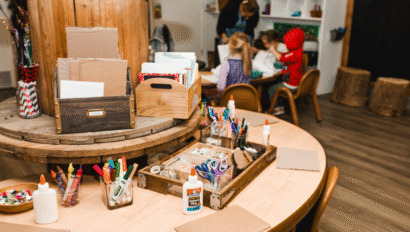
At Dolce Early Learning Center in Fishers, Indiana, the atelier is a dedicated studio space where children use art, materials, and hands-on investigation to explore real ideas — not just make crafts. It’s one of the defining features of Reggio-inspired education, and one of the clearest reasons Dolce offers something genuinely different from other early childhood programs in the area.
When Your Child Comes Home Talking About Something You Didn’t Expect
You’ve probably had a pickup moment where your child launches into a story you can’t quite follow — something about a color that changed, or a structure that fell, or a question the whole class couldn’t stop thinking about. The energy is different from “we did art today.” There’s something underneath it. A curiosity that didn’t get resolved, so it came home with them.
That’s the atelier at work.
Most preschools have an art corner. A few tables, some markers, maybe a sensory bin. Dolce has something different — a dedicated studio space built around the idea that children’s thinking deserves a real place to unfold.
What the Atelier Actually Is
The atelier isn’t an art room in the traditional sense. It’s a space specifically designed for children to investigate ideas through materials. Paint, clay, light, natural objects, loose parts — the tools change depending on what children are exploring, but the purpose stays the same: to give children a way to work through questions they can’t yet answer with words alone.
In Reggio-inspired education, children communicate through what educators call the “hundred languages” — drawing, building, sculpting, moving, imagining. The atelier is where many of those languages get spoken. Reggio Children, the organization founded in Reggio Emilia, Italy that continues to develop and share this approach globally, describes the atelier as a place where children’s poetic languages and scientific thinking come together — where aesthetic experience and inquiry aren’t separate things, but part of the same process.
At Dolce, that philosophy shapes how the space is set up, what materials are available, and how educators use what they observe there to guide what comes next.
How the Atelier Shapes Learning at Dolce
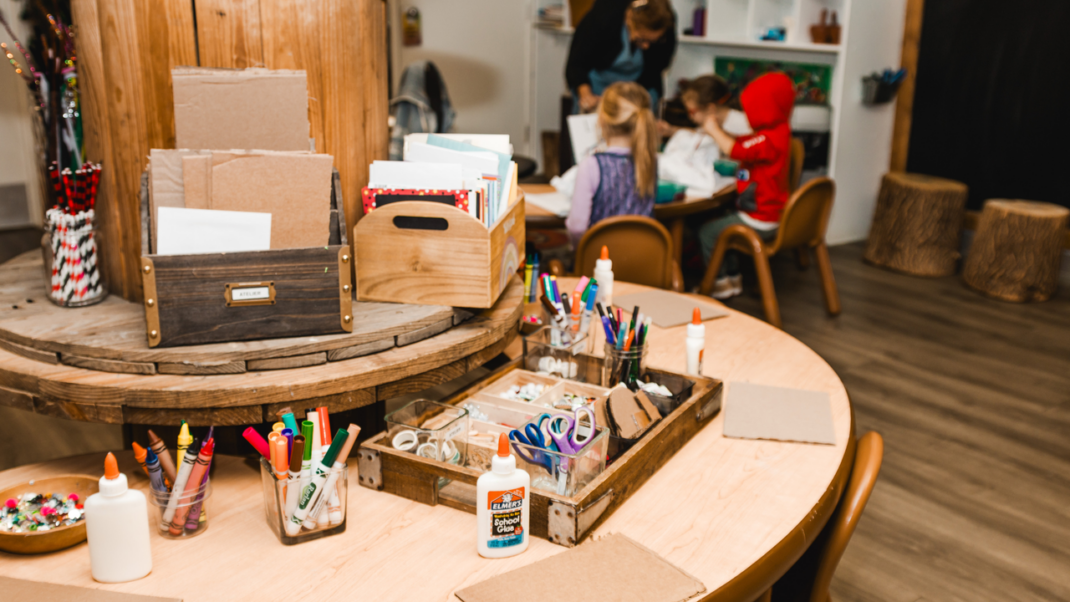
Walk into Dolce’s atelier on any given morning and you might find a group of preschoolers pressing leaves into clay, trying to capture what they noticed on a walk outside. Or a pair of children mixing watercolors with water they collected during a rainy-day investigation, watching what happens when the ratios shift. Or a small group returning — for the third day in a row — to a collaborative structure they’re not finished with yet.
These aren’t isolated activities. They’re part of longer investigations that emerge from the children’s own questions and interests. An educator might notice that several children have become fascinated by shadows during outdoor time. That observation finds its way into the atelier, where children begin experimenting with light sources, tracing outlines, and eventually representing what they discovered through drawing or collage.
The atelier makes that kind of sustained, connected learning possible. It gives children a place to come back to — and coming back is where the real thinking happens.
What This Looks Like Compared to Other Programs in Fishers
There are a lot of good preschool options in Fishers. Families considering Dolce will likely also look at programs that are well-run, warm, and caring. The difference isn’t about which school is more loving or more structured. It’s about what children spend their time doing, and why.
At programs built around a franchise model — even high-quality ones — the curriculum is standardized. The same activities happen across hundreds of locations on a predictable schedule. There’s real value in that consistency. But the atelier represents something different: a learning environment that actually changes based on what the children in that specific room are curious about right now.
At Dolce, educators observe children, document what they notice, and use that documentation to shape what happens next in the atelier and beyond. The curriculum isn’t delivered to children — it’s built alongside them. That distinction matters, especially for families who want their child to be known as an individual, not moved through a program.
What Children Build Through Atelier Work
Children who spend regular time in the atelier develop something you can actually watch grow over the course of a year: the ability to sit with a problem, try something, notice what happened, and try again differently. That persistence and flexible thinking shows up later in how children approach reading, math, friendships, and challenges they haven’t encountered yet.
They also develop confidence in their own ideas. When a child’s question becomes the starting point for a week of investigation — when their curiosity is treated as worth following — that child learns something important about themselves. Their thinking matters. Their ideas have weight.
That’s a different kind of school readiness than knowing how to write your name before kindergarten. And it’s the kind that tends to last.
Frequently Asked Questions
Does my child need to be artistic or creative to benefit from the atelier?
Not at all. The atelier isn’t about artistic talent — it’s about exploration and thinking. Children use materials to investigate ideas, work through questions, and express what they’re noticing. Some children gravitate toward clay, others toward building or drawing. The space is designed to meet each child wherever their curiosity leads.
How is the atelier different from free play or regular art time?
Free play and creative art time are both valuable, and Dolce incorporates both. The atelier is distinct because it’s connected to longer investigations that children return to over days or weeks. Educators document what happens there and use those observations to guide the direction of learning. It’s purposeful exploration — open-ended, but intentional.
Will my child bring home a finished project from the atelier every day?
Sometimes, but not always. Some of the most meaningful atelier work is ongoing — a structure still being built, a question still being explored. You’ll often hear more about the process than see a finished product, and that’s by design. The learning lives in the doing, not just the outcome.
How do Dolce’s early educators in Fishers, IN use what happens in the atelier?
Educators at Dolce observe children closely in the atelier and document what they see — through photos, notes, and displays of children’s work. That documentation becomes a resource for planning: it helps educators recognize what children are curious about and build experiences that go deeper. It’s also a window for families into how their child thinks and engages.
Children who are curious deserve a space that takes their curiosity seriously. That’s what the atelier at Dolce is built to do — and it’s something you really do have to see to fully appreciate.
We’d love to show you what this looks like on an ordinary Tuesday morning. Schedule a tour at Dolce Early Learning Center in Fishers, Indiana and come see the atelier for yourself.
Related Posts
All Posts
How Reggio-Inspired Preschools Build Curriculum Around Your Child in Fishers, IN
Inside Fishers, IN’s Reggio-Inspired Classrooms: What High-Quality Practice Actually Looks Like